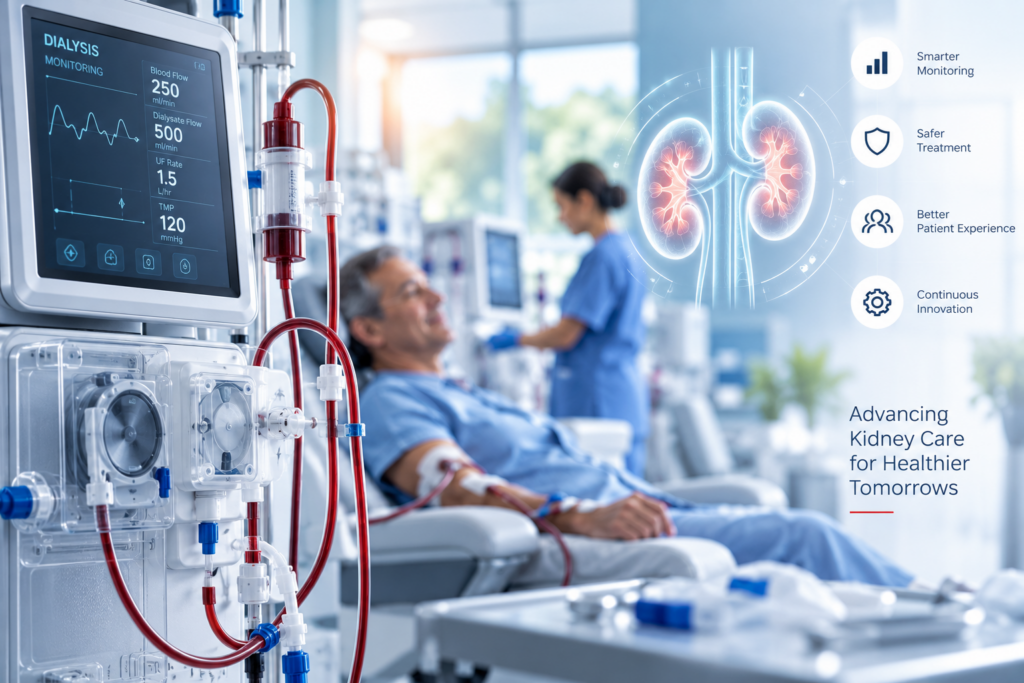
Kidney health is a fundamental part of overall health. When the kidneys can no longer perform their essential functions adequately, dialysis can become a critical part of a patient’s care.
But dialysis is not simply about a machine or a single medical device.
It is a complex clinical process involving equipment, consumables, water quality, monitoring, infection prevention, trained healthcare professionals and carefully controlled procedures.
As healthcare technology continues to evolve, innovation is creating opportunities to make dialysis care more efficient, connected, consistent and patient-centred.
Why Dialysis Innovation Matters
Dialysis care requires precision.
Patients may undergo treatment repeatedly over long periods, making reliability and consistency especially important.
Every component involved in treatment has a role to play—from fluid management and vascular access to tubing, filtration and monitoring.
For healthcare providers, this means medical-device quality is closely connected to the overall treatment environment.
Small improvements can matter across the entire care pathway.
4 Areas Shaping the Future of Dialysis
01 — Smarter Monitoring
Modern healthcare is increasingly capable of collecting and analysing information during treatment.
Better monitoring can help healthcare professionals observe important parameters and respond appropriately when clinical conditions change.
The broader direction of healthcare is moving toward more informed and data-supported decision-making, while clinical judgement remains central.
02 — Better-Designed Consumables
Dialysis depends on a wide range of consumables and accessories.
Their design, material selection, compatibility and manufacturing consistency can all contribute to dependable clinical workflows.
The objective isn’t necessarily to make every component more complicated.
Sometimes, innovation means making a product:
simpler to use · more consistent · easier to handle · better suited to clinical workflows
03 — Infection Prevention & Process Control
Infection prevention remains an essential consideration in healthcare environments.
For dialysis services, maintaining appropriate hygiene, sterilization and handling practices is part of creating a safe treatment environment.
Technology can support these processes, but well-designed systems and disciplined clinical practices must work together.
04 — More Patient-Centred Care
Technology is also changing how healthcare professionals think about the patient experience.
Future dialysis solutions can increasingly focus on reducing unnecessary complexity, improving usability and supporting more efficient care delivery.
The ultimate objective is not simply better technology.
It is better healthcare for the person receiving it.
Where Innovation Meets Reliability
Healthcare innovation is sometimes associated with futuristic machines or artificial intelligence.
But some of the most meaningful improvements can happen in less visible areas.
Better materials.
Better product design.
More consistent manufacturing.
Improved packaging.
Clearer clinical workflows.
Reliable supply.
These improvements may not always attract attention, but they can make an important difference to healthcare professionals who use medical devices every day.
Building a Stronger Dialysis Ecosystem
Dialysis care depends on an ecosystem of manufacturers, healthcare providers, distributors and clinical professionals.
A medical-device company therefore has responsibilities that extend beyond producing individual products.
It must understand:
- Clinical requirements
- Product consistency
- Quality expectations
- Supply continuity
- Healthcare-partner needs
- International market requirements
Varni Corporation’s medical portfolio includes dialysis among its key healthcare areas, alongside critical-care and hospital solutions.
This gives Varni an opportunity to contribute to an important part of the broader kidney-care ecosystem.
What Could the Future Look Like?
The next generation of dialysis care is likely to be increasingly connected and data-informed.
We can expect continued development around:
Connected monitoring
Better access to treatment information.
Digital healthcare systems
Improved coordination between clinical teams and patients.
Advanced medical materials
Continued improvement in device performance and usability.
Personalized care
Healthcare increasingly adapted to individual patient needs.
More efficient workflows
Technology helping healthcare professionals spend more time where it matters most.
But innovation should always be evaluated through one fundamental question:
Does it make healthcare safer, more effective, more accessible or easier to deliver?
Varni Corporation’s Perspective
At Varni Corporation, we believe healthcare innovation should remain grounded in real clinical needs.
Our approach combines a broad medical-device portfolio with a focus on quality, dependable healthcare solutions and global partnerships.
As kidney care continues to evolve, the industry will need solutions that balance technology with reliability and practical clinical requirements.
Because the future of healthcare isn’t just about creating new technology.
It’s about creating better ways to care for people.
A Better Future for Kidney Care
Dialysis has already transformed the lives of millions of people living with kidney failure.
The next chapter will be shaped by continuous improvement—better technologies, better processes, better products and stronger collaboration across healthcare.
At Varni Corporation, we see this evolution as an opportunity to support healthcare professionals and partners with solutions designed around a simple principle: