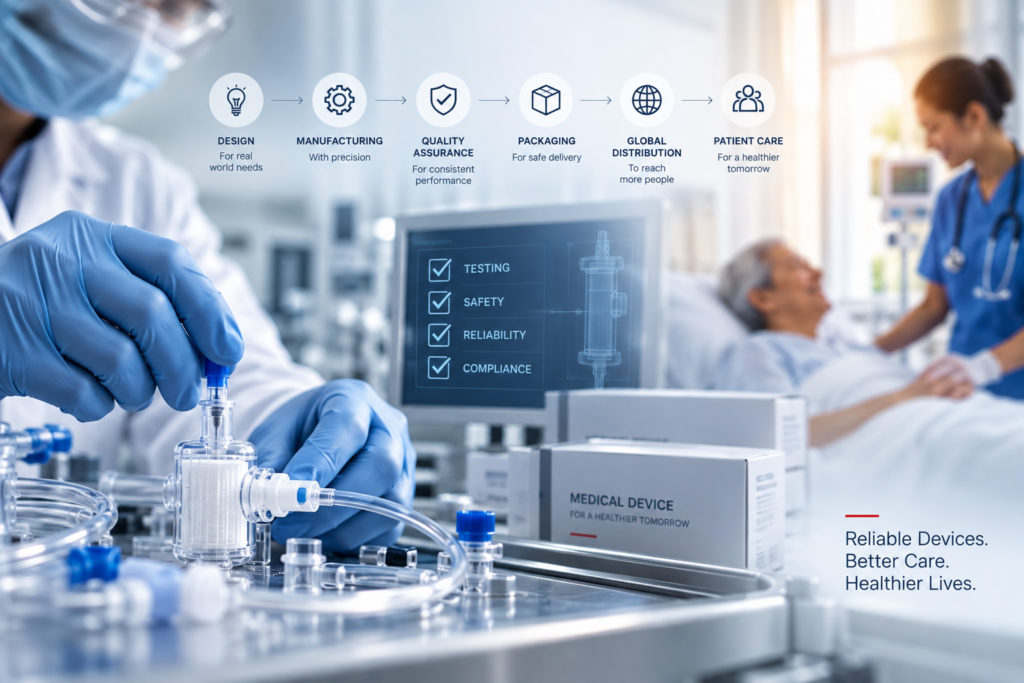
A medical device may look simple on the outside. But behind every reliable product is a chain of decisions involving design, materials, manufacturing, quality control, testing, packaging and distribution.
In healthcare, reliability is more than a product specification.
It is a responsibility.
For healthcare professionals and patients, the quality of a medical device can influence how confidently a procedure is performed, how efficiently care is delivered and how consistently a healthcare system operates.
That is why the journey of a medical device—from concept to clinical use—matters.
Quality Begins Long Before the Product Reaches a Hospital
A dependable medical device is not created at the final inspection stage.
Quality has to be considered throughout the entire product lifecycle.
This includes:
Design → Materials → Manufacturing → Quality Control → Packaging → Distribution → Clinical Use
Each stage creates an opportunity to improve reliability—or introduce risk.
A strong quality-focused approach therefore treats manufacturing not simply as production, but as a controlled process designed around consistency and patient needs.
5 Pillars Behind Reliable Medical Devices
01 — Purpose-Driven Design
Every medical device begins with a healthcare need.
Good design considers how a product will actually be used by healthcare professionals, the environment in which it will operate, and the practical challenges faced during clinical procedures.
The goal is not simply to create a technically advanced product.
It is to create a product that is appropriate, dependable and practical in real-world healthcare environments.
02 — Material & Manufacturing Quality
The materials used in a medical device can directly influence its performance, durability and reliability.
Consistent sourcing and controlled manufacturing processes help reduce variation and support predictable product performance.
For manufacturers and healthcare partners, consistency is critical:
The same product should deliver the same expected performance, time after time.
03 — Quality Assurance Is a Continuous Process
Quality should not be treated as a final checkpoint.
It is an ongoing process involving inspection, documentation, process controls and continuous improvement.
For international healthcare businesses, quality systems also help create confidence between manufacturers, distributors, hospitals and other healthcare partners.
Varni Corporation’s own positioning emphasizes quality-focused processes and international healthcare standards as part of its approach to global medical solutions.
04 — Packaging & Distribution Matter Too
Even a well-manufactured medical device needs appropriate protection throughout its journey.
Packaging, storage and transportation can become important factors in maintaining product integrity before the device reaches its intended destination.
This becomes especially important when products move through international supply chains.
Varni’s global distribution focus means reliability has to extend beyond manufacturing—into the wider process of serving healthcare partners across international markets.
05 — The End Goal Is Patient Care
Ultimately, a medical device does not exist simply to be manufactured.
It exists to support healthcare.
Whether it is used in dialysis, critical care, surgery or another clinical environment, the product becomes part of a much larger healthcare ecosystem involving clinicians, technicians, distributors, hospitals and—most importantly—patients.
That is why quality, reliability and usability have to work together.
Why Reliability Matters in Global Healthcare
Healthcare systems around the world operate under different conditions.
Different regulations.
Different infrastructure.
Different clinical environments.
Different supply-chain challenges.
Yet one requirement remains universal:
Healthcare professionals need confidence in the products they use.
For global medical-device companies, building that confidence requires more than offering a large product portfolio.
It requires consistency, responsiveness, quality assurance and dependable partnerships.
This is particularly important for organizations working across multiple clinical categories and international markets.
Varni Corporation currently presents itself as a global healthcare partner serving distributors, hospitals and healthcare institutions across 50+ countries.
Beyond Products: Building Healthcare Partnerships
The modern medical-device industry is increasingly about collaboration.
Manufacturers need to understand the requirements of healthcare providers.
Distributors need dependable supply and communication.
Healthcare institutions need products that fit their operational requirements.
And patients ultimately depend on the entire system working together.
At Varni Corporation, this is why we believe a strong healthcare partnership is built on three fundamentals:
Quality. Reliability. Responsiveness.
Our goal is not simply to move products across borders.
It is to help healthcare partners access dependable medical solutions that support better care.
The Future of Medical Devices
The next generation of medical devices will undoubtedly become more connected, data-driven and technologically advanced.
But technology alone will not define the best healthcare products.
The fundamentals will remain:
Safety.
Quality.
Reliability.
Consistency.
Human needs.
Innovation becomes meaningful when it solves a real healthcare problem—and does so reliably.
At Varni Corporation, we believe the future of healthcare is built one reliable solution at a time.
Better Products. Better Partnerships. Better Healthcare.